
Field notes Electrical and NFPA 70B
What an electrical thermography scan needs from your facility
What has to be true before a thermal scan of your electrical gear is worth doing — covers, load, and what the reading can and can't tell you.
- Topic
- Electrical and NFPA 70B
- Field notes
- Published
- Sep 20, 2026
- Reviewed Sep 2026
- Sections
- 12
- With sources
- Sources
- 6
- Cited in full
What the scan needs from you
The morning of an electrical thermography scan, the facility has more to do than the thermographer.
Somebody has to open the panels. Somebody has to have the equipment running under a real load. Somebody has to know what’s on the list, what isn’t, and why.
None of that is our work. It’s yours. If it isn’t done, the scan is a walk through a room with a camera.
A lot of vendor pages skip this. They describe the camera and the report. The facility finds out on the day what it should have arranged. So this piece is the part they skip. What has to be true before we arrive. What the reading actually is. What it can’t tell you, and what happens after. And where the maintenance standard fits — without pretending it says more than it does.
If you came for one thing:
- Why the covers come off, and who takes them off
- Why an unloaded circuit tells you nothing
- A difference, not a temperature
- What else makes a hot spot
- What confirms a finding
- Where NFPA 70B fits
Why a warm connection is worth finding
Here’s how a connection fails. It loosens a little. Resistance rises. Current pushing through that resistance makes heat. The lug runs warmer each month than the one beside it. Then one day it arcs, and the panel is out.
Reliability engineers have a name for the gap between the first warm reading and the arc. They call it the P–F interval. P is the point where a developing failure first becomes detectable. F is the point where it becomes a failure. Everything useful happens in between.
An inspection program exists to look inside that window. Look often enough to catch P before F arrives. Then the repair goes on a work order instead of into an outage.
On an electrical connection, the first detectable sign is heat. A bad connection makes heat before it makes anything else. That’s what a thermal scan is for. It finds P.
The camera can’t see through a closed panel
Which is why the covers come off, and why who takes them off is the first thing we settle.
A thermal camera reads the surface in front of it. Point it at a closed panel and it reads the door. The door is at room temperature. The lug behind it that’s running hot doesn’t show, because the door is in the way.
So the standard says what practice already knew. The 2026 edition of NFPA 70B requires that accessible and necessary covers be removed before the scan. The reason is a clear line of sight.
Taking a cover off energized equipment is electrical work. It’s done by a qualified person, under your site electrical safety program, in the gear that program calls for.
That person is your electrician. Or a qualified contractor we coordinate before the visit. Either way, we don’t open energized equipment. We scan, measure, classify, and document. Your qualified person opens and closes.
Panels with infrared windows are the exception. The standard’s annex notes that a window can provide the line of sight without removing the cover. A window covers what’s in its field of view, not everything behind the panel. A panel with one window and six terminations is a panel with one window.
This is why our first call asks who’s opening covers before it asks anything else. It’s also why the equipment list matters. A panel nobody can open on the day goes in the report as not scanned. It doesn’t quietly disappear.
An unloaded circuit tells you nothing
A bad connection makes heat when current runs through it. No current, no heat. Scan a panel with the breaker open and every lug reads the same as the enclosure.
So the scan is scheduled around your production, not around a shutdown. The equipment has to be running and carrying a real load. The 2026 edition requires the inspection be done online, under an operating load. Its annex suggests at least 40 percent of nominal circuit loading as a guide. That’s a suggestion, not a requirement. And it’s a share of the circuit’s normal load, not the equipment’s rating.
Two things follow.
A lightly loaded circuit can hide a real defect. A connection that’s fine at light load and dangerous at full load reads fine at light load. If your plant runs three shifts and we scan on the quiet one, the report is about the quiet one.
And the load gets written down. Every anomaly in the findings table carries the load on that circuit at the time it was read. Not assumed from a nameplate — taken from your metering or the equipment’s own readout, and logged beside the reading. A temperature difference without the load beside it is a number nobody can interpret next year.
This is why our first call asks when your equipment is working hardest. That’s when we want to be there.
A difference, not a temperature
A lug reading warm means nothing on its own. In a cold switchroom in January it might be a problem. In a pump house in August it might be the coolest thing in the panel.
The number that means something is a difference. How much hotter is this part than something it should match?
The 2026 edition asks for two comparisons. It asks for both.
The first is like against like. This lug against the same lug on the next phase, carrying similar load, on the same day. Three phases of a balanced load should read alike. When one doesn’t, the difference is the finding. This comparison cancels almost everything that isn’t the defect. The room, the season, the enclosure, the emissivity setting — all the same for all three, so they drop out.
The second is the part against the air around it. That one catches what like-to-like can’t. If all three phases are running hot because the whole panel is overloaded, they still match each other. Against ambient, they don’t.
Two comparisons, two numbers, both recorded for every anomaly. That’s what the standard asks for, and it’s what the findings table carries.
Why not just report the temperature? Because a temperature moves with everything. Change the emissivity setting and it moves. Change the distance and it moves. Change the day and it moves. A difference between two parts, read the same way seconds apart, holds still. It’s the number an auditor can check against next year’s scan.
That’s also why every reading in the report says what it was compared against. A difference without its reference is just a temperature again.
What else makes a hot spot
A hot connection is one reason a part reads warmer than its neighbors. Here are the others, because every one of them shows up in a scan.
Overload. A conductor carrying more than it should heats along its whole length, with nothing wrong at any connection. Same heat, different cause. This is the one that fools people most.
Unbalance and harmonics. Three phases carrying different currents read differently. Not because a lug is bad, but because the loads aren’t equal. Certain loads also push extra heat into neutrals and transformers.
Reflection. Bright metal reflects. A polished bus bar can show you the hot lamp behind you, or your own body heat. It reads hotter than it is.
Emissivity. The camera assumes how readily a surface gives off infrared. Shiny copper and dull painted steel give it off very differently. Read both with one setting and one of them is wrong.
Sun. Outdoor gear read from the air carries whatever the sun put into it. A south-facing transformer tank in July reads warm because it’s been sitting in the sun, not because it’s failing.
Parts that run hot by design. Heaters, some relays, bimetal elements. Things that are supposed to be warm. That’s not a finding.
Something that just happened. A load that switched on a minute ago hasn’t reached temperature. One that switched off is still cooling.
Air. A fan, an open door, a gap in the enclosure. Anything moving air across one part and not another.
Every one of those can look like a bad connection in a thermal image. Most can be told apart on site. The visible photo sits beside the thermal one, and the load beside the reading. Some can’t. Those go in the report as a difference with a probable cause, flagged for your electrician to confirm.
What the scan cannot tell you
Plainly, so it’s settled before you hire anyone.
It cannot tell you why. Thermography says which part is running hot, by how much, and compared to what. It could be a loose lug, a corroded contact, a failing winding, or a conductor too small for its load. Finding out takes opening, testing, or servicing the equipment.
It cannot tell you the lug is loose. A hot termination is a pattern consistent with a bad connection. It’s also consistent with overload, and the two look the same from outside. Which one it is gets settled with a current reading and a torque check, not a camera.
It cannot certify anything. The report documents measured conditions and grades them against a published convention. It doesn’t say the equipment is fit for service, and it doesn’t stand in for an engineer of record.
It cannot tell you when. A part running hot today might run hot for years or fail next week. The scan finds the warm reading. How fast it’s getting worse takes a second scan against the first.
It cannot see what wasn’t opened. A closed panel is a closed panel. It goes in the report as not scanned.
It cannot see inside a tank from the air. Outdoor gear read from above shows the outside of the tank and the bushings. What’s inside a sealed transformer is a different inspection.
That’s a lot of cannots. Here’s what the scan does do: it finds the warm part, before anything else can, while the equipment is running. Everything after that is your electrician’s work, aimed at a location instead of a whole room.
What confirms a finding
The findings table hands your electrician a list of locations. Here’s the chain that turns a location into a repair, or into nothing.
Read the load. Before anyone opens anything: what current is that circuit actually carrying? If the reading is hot and the load is high, overload is the first suspect. If the load is normal and one phase is hot, it’s the connection.
Look. Discoloration, pitting, a burnt smell, a loose strand, a lug that turns by hand. Many findings resolve here.
De-energize and check torque. The definitive test for a suspected connection is a torque wrench on the termination with the power off. That’s your electrician, under your program. Not us.
Log the power quality, if it’s a phase or a neutral. Where the pattern is unbalance or harmonics rather than a single hot point, a photo won’t answer it. A power-quality logger over a shift will.
Test the motor, if it’s a motor. Windings, bearings, and couplings each have their own test. A warm bearing housing is a reason to run them, not a diagnosis.
Read it again. After the repair, the same part read the same way should match its neighbors. That’s the record that the finding was real and the fix worked.
Where a finding needs more than a look, the report says what kind of more. A probable cause, and the test that settles it. Not a diagnosis — a direction.
Where NFPA 70B fits
NFPA 70B is the standard for electrical equipment maintenance. The 2026 edition is current. If you’re working from the 2023 edition, some of what it says has changed.
We don’t reproduce the standard here, and we don’t tell you what it requires of your facility. That’s between you, your code authority, and your insurer. What we can tell you is how it treats the work we do.
The standard recognizes more than one way to meet its thermography requirements. A periodic scan — a calibrated camera, on a schedule — is one. Permanently installed temperature monitoring is another. The 2026 edition says so directly.
They see different things.
Continuous monitoring watches the points it’s installed on. Usually that’s bus bars and terminations inside critical switchgear. It watches them all the time, which a scan can’t do. And for those points, the standard treats it as satisfying the same test a scan would.
A scan covers what you point the camera at. The disconnect nobody instrumented. The motor and its bearing. The panel added after the sensors went in. The transformer out in the yard. A scan also tells you where sensors belong, if you’re deciding.
The people who sell monitoring sensors say the same thing. Grace Technologies makes them. It says the goal is not “to replace maintenance intervals, inspections or engineering judgment with a sensor.” It also says monitoring on its own doesn’t make a program compliant.
So the choice isn’t one or the other. It’s what each one should cover at your site.
On intervals, the standard doesn’t start with a number. It starts with the manufacturer’s maintenance instructions, where you have them. Where you don’t, it allows predictive methods. That includes setting the interval from how fast a failure develops, the window described earlier. And where a facility has neither, the standard’s own table is the default. Twelve months for most equipment. Six for equipment at the highest condition assignment.
That’s the case for a lot of facilities. Worth knowing that the number everyone quotes is the fallback, not the headline.
Condition, in the standard’s sense, is the highest of three assessments. The equipment’s physical condition. How critical it is. The environment it runs in. A clean panel in a critical service in a dusty room can land in the top condition. Criticality or environment alone will put it there.
What all that means for your gear is your call, made with your edition open.
One more thing, because you’ll hear it from vendors. Insurers increasingly expect to see a dated, condition-based record. What they publish about intervals isn’t uniform — carriers differ, and so do facilities. If a vendor says your carrier wants an annual scan, ask which carrier, and ask to see it in writing.
What you receive
Five things land in the folder. The specimen plates on our work page show the format before you talk to us. Demonstration data throughout, stamped on every plate.
Radiometric thermal images. Full-radiometry files, not screenshots. Your reviewer can put a cursor on any pixel and re-measure it, instead of taking our number on trust.
The findings table. One row per anomaly. Each row carries an ID, the asset and component, and where it sits on the map. The load on that circuit at the time. Whether the panel was read with the cover off or through a window. Both temperature differences: against the matching component, and against ambient. A severity class, and the action that class calls for. Class 1 means look into it. Class 2 means schedule the repair. Class 3 means monitor until it can be repaired. Class 4 means repair now. CSV for your maintenance system, PDF for the file.
A photo beside every thermal image. So the finding names a real component, not a warm patch.
An equipment inventory and location map. What was scanned, what wasn’t, and where it all sits. The next scan covers the same list, so the two can be compared row by row.
A method report. Emissivity and reflected-temperature settings. Load and conditions on the day. Which panels were read open, which through a window, which not at all. And the limits of the result, stated.
Two things about the findings table worth saying plainly. The severity classes grade a measured difference against a published convention. They say how much, not why. And “not scanned” is a row, not an omission. A panel nobody could open on the day shows up in the inventory with the reason.
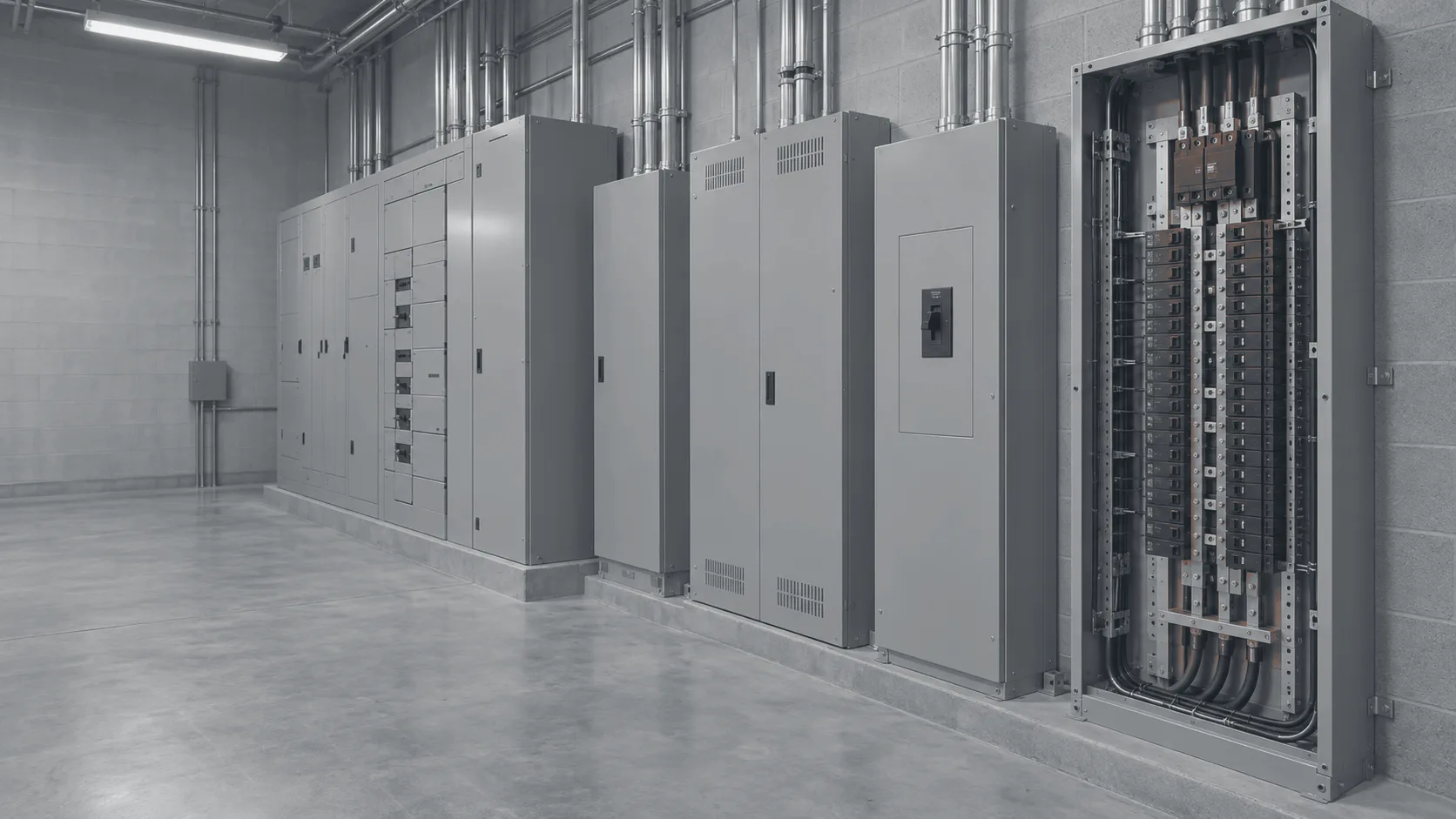
If a room like this is what you’re looking at, the electrical service page has scope and timing.
If you want to talk about a panel
A short call covers three things. What’s on the equipment list, indoors and out. Who’s opening the covers, and whether any panels have windows. And when your equipment is working hardest, because that’s when we need to be there.
We’re owner-operated. The person who plans the scan is the person who reads the panels and signs the report.
Some rooms are a bad fit for thermography. Sealed gear, nobody to open it, a load that can’t be brought up. We’ll tell you on the call rather than after the invoice.