
 Illustration
Solution · For property managers and commercial building owners
Budget the roofs on condition, not on age.
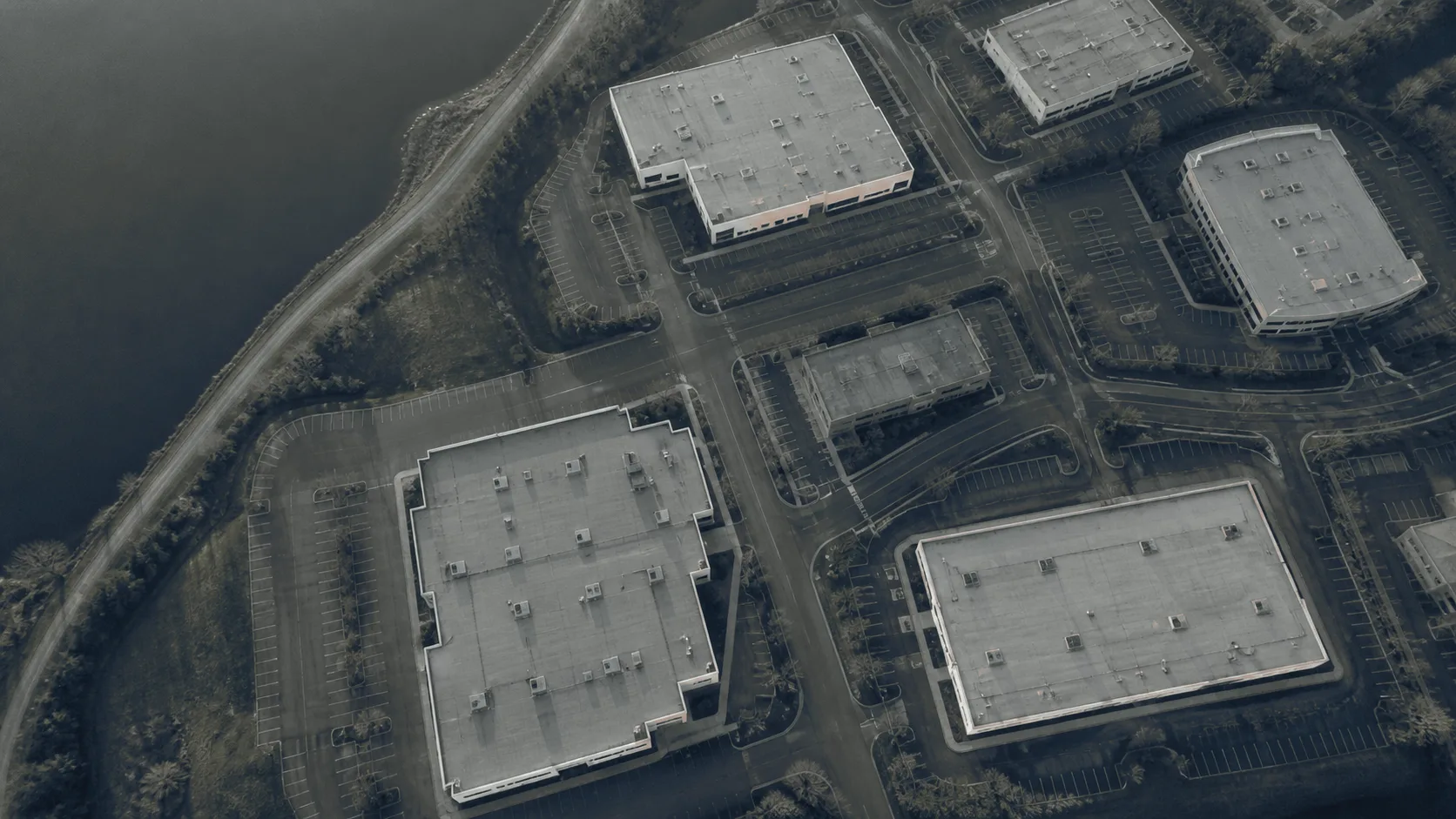
Every roof in the portfolio is flown on a fixed annual or semiannual cycle and assessed by the same method. Full-surface imagery, an infrared moisture survey, and a condition report per building. The portfolio view ranks them against each other. Preventive maintenance and capital planning are built on what the roofs are actually doing. Every flight becomes your baseline, so the next one shows what changed.
- Cycle
- Annual
- or semiannual
- Method
- ASTM C1153
- infrared roof moisture
- Per building
- Condition report
- PDF + scaled plan
- Across the portfolio
- Ranked view
- CSV + summary
How the capital plan gets built.
Without a program is how roof CapEx is usually decided across a portfolio. Under a program is what goes in front of the same meeting instead.
Without a program
Under a program
- Replacement is scheduled off roof age and warranty expiry, because that is the only data anyone has on every building.
- Each roof carries a current condition assessment, so the estimated remaining service life is evidence, not a guess by age.
- The roof that gets money is the one attached to the loudest tenant complaint this quarter.
- A ranked portfolio view. The roof that needs the money and the roof that is making noise can be told apart.
- Preventive maintenance happens where somebody remembers, and its effect is impossible to demonstrate at budget time.
- Last year’s flight and this year’s flown the same way. A repair that held and a repair that did not are both visible.
- A capital request is carried by a contractor’s recommendation and a photograph.
- An independent condition record, produced by someone with nothing to sell on the repair. In a document a board can read.
- When something does happen, the roof’s condition beforehand is a matter of recollection.
- A dated pre-loss baseline on every building in the portfolio. A by-product of the cycle, not a separate purchase.
Method
The same ground, the same way, every cycle.
Each building is flown at a fixed altitude, overlap and camera configuration, and those settings ship with the deliverable. The next cycle re-flies them exactly. That is the only reason two years of imagery can be compared rather than merely collected.
The visible pass documents the surface and every seam, flashing, penetration, drain and mechanical curb. The infrared pass is flown at night on our roof-survey conditions: about an hour after sunset, after a day of sun, with no appreciable rain in the previous 24 hours and wind under about 15 mph. It outlines areas holding heat the way retained moisture does, flagged for a core.
Reporting comes back at two scales. Each building gets its own condition report on a scaled plan. The portfolio gets a ranked summary. Which roofs moved, which held, and where the wet area grew since the last cycle.
What you receive.
- PDF + DXF 01 Condition report per building Findings numbered on a scaled roof plan and rated for urgency. Estimated wet area totaled; conditions and settings logged.
- PDF + CSV 02 Ranked portfolio summary Every roof in one table: condition, wet area, and the change since the last cycle. Ordered so the capital conversation starts at the top.
- PDF + GeoTIFF 03 Year-on-year comparison This cycle registered against the last over the same ground. Growth in a wet area is measured, not remembered.
- PDF + KMZ 04 Repeatable capture record Route, altitude, overlap and camera settings for every building, so any future cycle covers the same ground the same way.
- XLSX 05 Capital-plan rows One per building and roof section, in your plan’s fields.
Stated before you commission it.
Questions we are asked
What buyers ask before they call.
Q1 How many buildings does this make sense for?
It starts making sense the moment roof spending is decided at portfolio level rather than building by building. For most managers that is somewhere around a handful of properties. Below that, the one-time moisture survey answers the question in front of you. The program earns its place when you need to compare roofs against each other and defend a sequence.
Q2 Annual or semiannual — how do we choose?
Annual is the normal cycle and suits a portfolio in steady condition. Semiannual is worth it where roofs are late in life. It is worth it where a membrane type is known to fail quickly once it starts. It is also worth it where a portfolio has just been acquired and you are still learning what you own. The interval is yours to set. We perform and document at whichever one you choose.
Q3 What does the first cycle give us that we do not already have?
A common baseline. Most portfolios have inconsistent records. Some roofs scanned recently by different vendors using different methods, others carrying nothing but an install date. The first cycle puts every roof on the same footing, measured the same way on the same kind of document. That is what makes the second cycle a comparison instead of another scan.
Q4 Can this feed our capital budget directly?
That is what the ranked summary is for. It gives you condition, estimated wet area and year-on-year change per roof, in a table. That is the input a CapEx forecast and a preventive-maintenance schedule are built from. We supply the condition evidence; your team and your contractor put costs against it.
Q5 What happens if a storm goes through mid-cycle?
The program is what makes that easier rather than harder. The pre-loss condition of every roof is already documented and dated. Post-storm capture is a separate, event-driven engagement, and the documentation side of a claim is covered by its own page. Both read against the baseline the program has been building.
Q6 Do you work for the roofing contractor or for us?
For you. We do not repair roofs, bid repairs, or take a position on who should do the work. That is the point of having condition measured by someone who is not also quoting on it. Your contractor is welcome to the same document, and most programs work better when they have it.
Q7 Is this a survey?
No. Our photogrammetric outputs document conditions for planning and comparison. They are not land surveys and are not offered as survey-grade or authoritative. Idaho reserves that word to licensed practice. Boundary or certified-elevation work is performed by a licensed Idaho professional land surveyor.
Who this is for
Written for property management and commercial real estate. The next decisions in the chain: is your roof insulation wet? and post-storm damage documentation .
Next step · The first cycle
Start with the portfolio you already worry about.
A short call counts the roofs and sizes the total area. It fixes the cycle and what the portfolio summary has to carry.
We reply within one business day.