
 Illustration
Electrical & industrial · Panel to substation
Catch the hot connection before it burns.
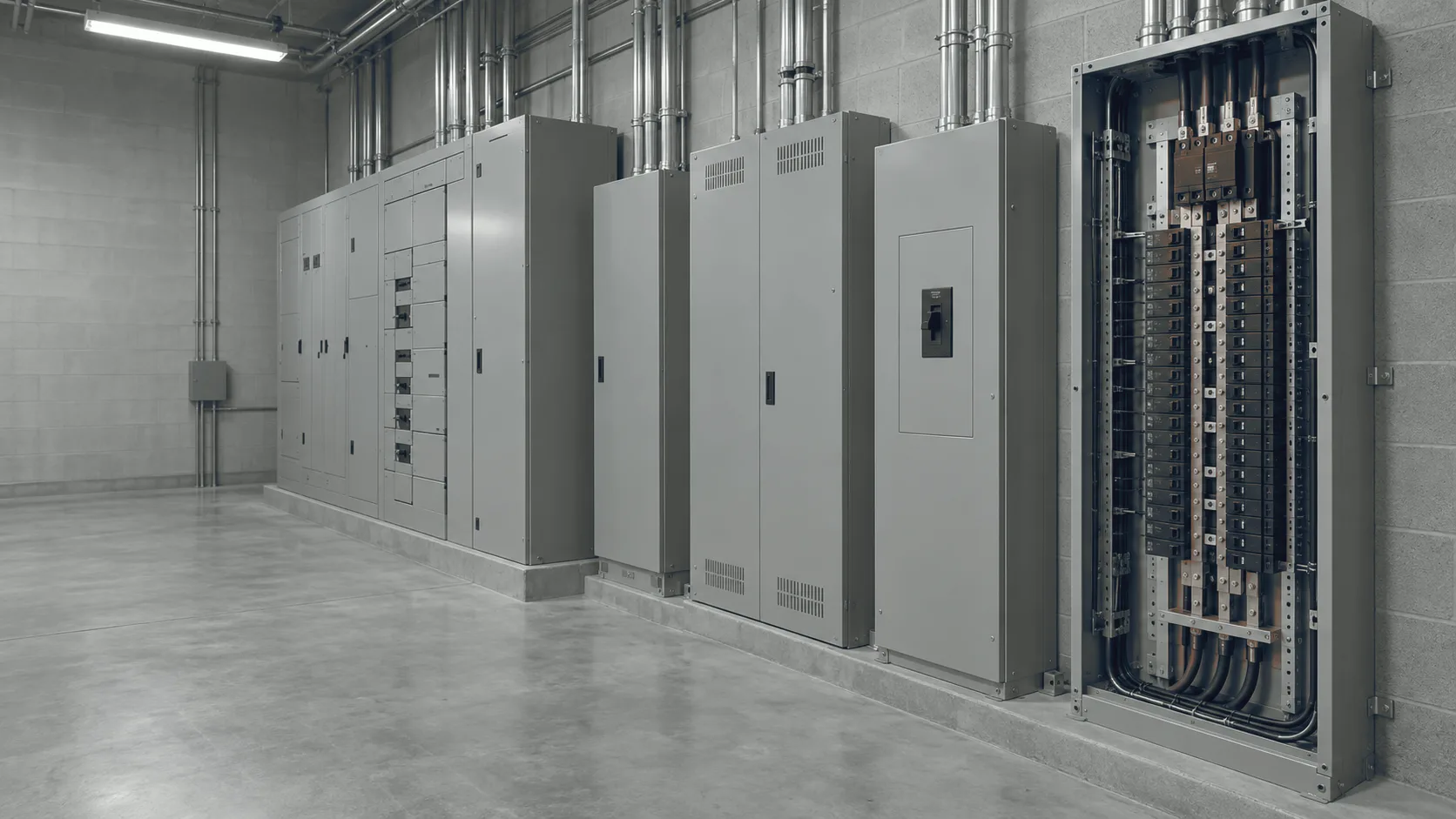
Thermal inspection of electrical and mechanical equipment, panel to substation, for plants, facilities and pumping stations. Panelboards, switchgear and motor control centers are scanned under load on the ground. Substations and rooftop gear are scanned from the air. Every anomaly is measured, graded for severity, and paired with a photo of the part it sits on.
- Method
- NFPA 70B
- 2026 edition
- Thermal sensor
- Handheld
- radiometric imager · specification stated in every report
- Vantage
- Ground + air
- chosen by target
- Grading
- Class 1–4
- severity per anomaly
Stakes
A developing fault is warm long before it is broken.
A loose connection, an overloaded conductor, a failing bearing. Each one runs hot for months before it fails. The heat can be measured while the equipment is running. The failure is measured in lost production.
From guesswork to measurement.
Guesswork is how most electrical rooms are checked today. Measurement is what a calibrated scan leaves behind.
Guesswork
Measurement
- A hand on the panel door, a nose for hot insulation, and a scan whenever someone remembers. At audit time, the records you need are the records you cannot find.
- A scan on a set interval, every temperature difference measured against a reference and written down. A report an auditor and an underwriter both accept.
- Run to failure. The first sign of a bad connection is the outage it causes, and the outage is measured in production.
- Loose and overloaded connections found while they are still only warm. Fixed on a work order, not a callout.
- Renewal comes around, and the condition of your equipment is argued from memory.
- A dated, condition-based record, which carriers increasingly expect to see.
Why it is scanned under load
An unloaded circuit tells you nothing.
Why is electrical gear scanned under load?
A bad connection only makes heat when current runs through it. Scan the same panel with the power off and every lug reads room temperature. So the scan is scheduled around your production, not around a shutdown. NFPA 70B has the inspection made online, under an operating load; its annex offers at least 40 percent of nominal circuit loading as a guide. Below that, a weak connection may have too little current to show.
The reading that matters is a difference, not a temperature — and the standard asks for two of them on every anomaly, not a preferred one and a fallback. The component against a similar component under similar loading: this lug against the same lug on the next phase, on the same day. And the component against the ambient air. Both go on the record beside the finding, with the load at the time, because neither comparison answers for the other.
What equipment is scanned indoors, and how?
Most of the equipment the standard covers is indoors, energized, and behind a cover. Panelboards, switchgear, motor control centers, disconnects and busway are scanned on the ground, under load, with the covers off. NFPA 70B requires every accessible and necessary cover removed before the inspection, so that what is being read has a clear line of sight to the camera. Your qualified electrician removes them, or we coordinate a qualified contractor to do it. Either way the work is done under your site electrical safety program, in the arc-flash gear it calls for. We scan, measure, classify and document. An infrared window provides that line of sight to whatever falls inside its field of view, and those components are read through it with the cover on; anything the window cannot see still needs the cover off.
The electrical yard is read the same way, from the air. A private substation, a transformer yard, outdoor switchgear and rooftop gear are scanned from above. Under load, against a comparable reference, the same as indoors. Nobody has to approach energized yard equipment to get the image. One visit covers the whole facility. The electrical room on foot, the substation and rooftop from the air, one severity-ranked report at the end.
- Hot termination · Class 4
Watch · 0:59
Electrical and industrial thermal inspection — scanned under load
Why electrical gear is scanned under load, how every anomaly is measured twice and graded, and what the findings sheet carries.
Transcript
A developing fault is warm long before it is broken. A loose connection, an overloaded conductor, a failing bearing. Many run hot for weeks or months before they fail. The heat can be measured while the equipment is running. The failure is measured in lost production.
A bad connection only makes heat when current runs through it. So the scan is scheduled around your production, not around a shutdown. The reading that matters is a difference, not a temperature.
Every anomaly numbered and located, compared against a similar component and the surrounding air, with the load at the time and its severity class. We document each finding both ways, following NFPA 70B, 2026 edition. We scan, measure, classify and document. We do not open energized equipment.
Based in Boise, Idaho. Mobilized across the Intermountain West. Start with one electrical room. Vertical Recon. Calibrated to defend.
What you receive.
- R-JPEG 01 Radiometric thermal images Full-radiometry files, so your reviewer can re-measure any point instead of taking our number on trust.
- CSV + XLSX + PDF 02 Findings table Every anomaly numbered and located, with two measured differences, the load at the time, and its severity class. We document each finding both ways, following NFPA 70B, 2026 edition. The first compares it with a similar component under similar loading, usually the same part on the next phase. The second compares it with the ambient air. Class 1 means look into it. Class 2 means schedule the repair. Class 3 means monitor until it can be corrected. Class 4 means repair now.
- JPEG 03 Paired visual imagery A photo of the same part beside every thermal anomaly, so the finding names a real component.
- PDF 04 Equipment inventory and location map What was scanned and where it sits, indoors and out. The next inspection covers the same list, so the two can be compared.
- PDF 05 Method report Emissivity and reflected-temperature settings, load and conditions, and the limits of the result. It records whether each panel was scanned open or through a window.
- CSV 06 Maintenance import file Findings mapped to your maintenance software’s import format, keyed to your own asset IDs. Equipment that doesn’t match your register is listed separately, never imported.
- PDF 07 Summary page What was scanned and what wasn’t, and why. Counts by class, top actions, change since last scan, next date. A record-of-repairs sheet comes with it; fill it in, and the next scan picks up from it.
How a job runs.
- 01 Scope Equipment list, indoors and out. Who removes the covers. What the report has to satisfy.
- 02 Scan Electrical room on foot, yard and rooftop from the air, with the equipment running and loaded. Load recorded.
- 03 Classify Each anomaly measured against a similar component at similar loading and against the ambient air, then graded Class 1 to 4.
- 04 Report Issued with a walkthrough. Class 4 items first, in plain terms.
What this is, stated precisely.
The standards this is written against.
Cited as the framework the report follows. We do not reproduce them, with one exception, sourced below.
- NFPA 70B, 2026 edition Standard for Electrical Equipment Maintenance
- Intervals are set through your own maintenance program. Manufacturer instructions govern first, then a predictive program; where there is neither, the standard’s table is the default — 12 months for most equipment, 6 months at the highest equipment condition assignment — and a documented deviation from it is permitted. Equipment condition is the highest of three parallel assessments: physical condition, criticality, and operating environment. Its infrared section sets the method the report follows: the inspection made online under load, each anomaly documented against a similar component under similar loading and against the ambient air, every thermogram paired with a photograph, and a severity class on every anomaly.
- ANSI/NETA MTS Maintenance Testing Specifications — infrared severity
- The published table the severity classes are read against, from the 2011 edition. It carries two scales. Comparing like parts under like load: 1 to 3 °C is a possible deficiency, to investigate; 4 to 15 °C is a probable deficiency, to repair as time permits; above 15 °C is a major discrepancy, to repair immediately. Comparing a part against the ambient air: 1 to 10 °C, 11 to 20 °C, 21 to 40 °C and above 40 °C. The four severity classes are those bands in the table’s own order, and the third has no like-for-like equivalent — a finding reaches Class 3 on the ambient comparison alone. Class is graded on both comparisons and reports the more severe. The table is reproduced as Table 1 of Zarco-Periñán, Zarco-Soto, Zarco-Soto and Martínez-Ramos, “Conducting thermographic inspections in electrical substations: a survey”, Applied Sciences 12(20), 10381 (2022), open access under CC BY 4.0 — doi.org/10.3390/app122010381.
Questions we are asked
What buyers ask.
Q1 Who takes the covers off?
Your qualified electrician, or a qualified contractor we coordinate before the visit. NFPA 70B requires every accessible and necessary cover off before the inspection, so each component has a clear line of sight to the camera — and taking a cover off energized gear is electrical work. It is done under your site electrical safety program, in the arc-flash gear it calls for. We scan, measure, classify and document. Where a panel has an infrared window, whatever falls inside its field of view is read through it with the cover on; anything the window cannot see still needs the cover removed.
Q2 Do you cover substations and outdoor electrical equipment?
Yes, on privately owned infrastructure. That means a plant substation, a transformer yard, outdoor switchgear and disconnects, or the service gear at a pumping plant. It is the same inspection as the electrical room: online under load, each anomaly read against a similar component at similar loading and against the ambient air. The load is logged beside each anomaly. Outdoor gear is scanned from the air, so nobody has to approach energized yard equipment to get the image.
Q3 Do you scan motors, bearings and other mechanical equipment?
Yes, on the same visit. Motors, bearings, couplings, steam lines and insulated pipe show a failing part or lost heat as a temperature pattern. They go in the same findings table, with the duty at the time noted beside each one.
Q4 Who actually buys this?
Three groups. Irrigation districts and canal companies, for the pumping plants and electrical gear that move their water. Industrial and food-processing plants with their own substations and distribution equipment. And electrical contractors doing commercial and industrial work, who bring us in to document a system they are responsible for.
Q5 Can this be done on the same visit as our canal or roof work?
Usually, and it is the efficient way to do it. A district scheduling a canal reach can add its pumping plants to the same trip. A facility booking a roof moisture inspection can have its electrical gear read the same day. The reports stay separate, because they answer to different standards and different readers.
Where this is used
The decision page: NFPA 70B thermography, documented . Written for facility and plant management.
Next step · One electrical room
Start with one electrical room.
A short call sizes the equipment list, settles covers and load, and fixes what the report has to satisfy.
We reply within one business day.