
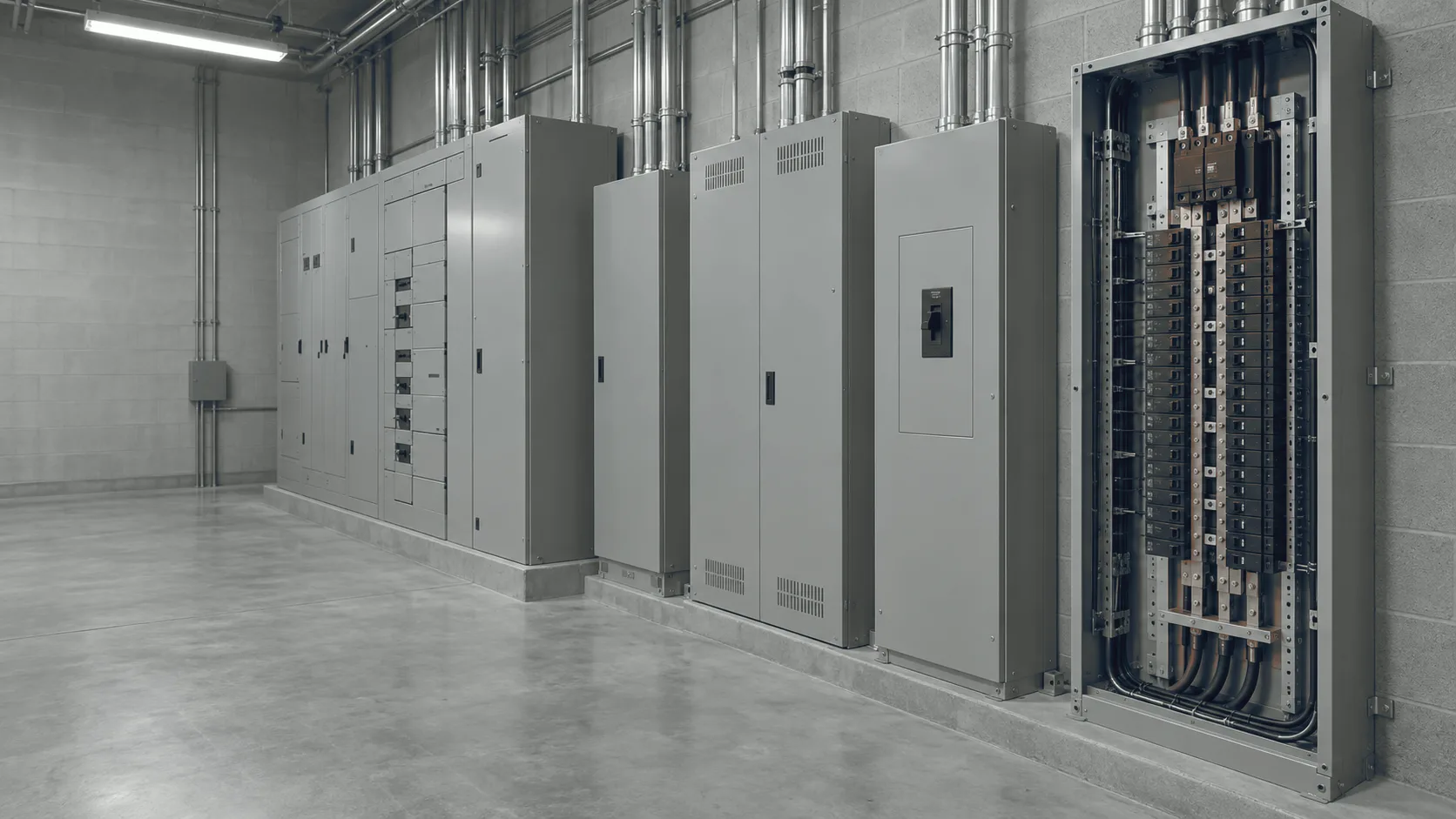
 Illustration
Solution · For facility and plant management
NFPA 70B thermography, documented.
An infrared inspection of electrical equipment online and under load, on the interval your maintenance program sets. Every anomaly is measured twice — against a similar component under similar loading, and against the ambient air — graded for severity and paired with a photograph of the component. It produces the documentation trail an auditor and an underwriter both ask for. And it finds loose and overloaded connections while they are still only warm.
- Method
- NFPA 70B
- 2026 edition
- Thermal sensor
- Handheld
- radiometric imager · specification stated in every report
- Condition
- Under load
- equipment running
- Grading
- Class 1–4
- severity per anomaly
What changes when the program is documented.
Before the program is condition-based maintenance without a record. Under the program is what a 70B-aligned inspection leaves behind.
Before the program
Under the program
- Scans happen when someone remembers, and the records nobody can produce at an audit are the records you have.
- An inspection on a set interval, with both differences documented for every anomaly. In the form an auditor and an underwriter both accept.
- Run to failure. The first sign of a bad termination is the outage it causes, and the outage is measured in production.
- Loose and overloaded connections found while they are still only warm. Scheduled into a work order rather than a callout.
- Premiums and claim exposure argued without a record of what condition the equipment was actually in.
- A documented condition-based program, with the paper trail carriers increasingly expect at renewal.
Method
Why it is scanned under load.
Why is electrical gear scanned under load?
A bad connection only makes heat when current runs through it. Scan the same panel with the power off and every lug reads room temperature. So the inspection is scheduled around your production, not around a shutdown.
What does NFPA 70B require the inspection to document?
What the sensor resolves is a difference, not a temperature. NFPA 70B has two of them documented for every anomaly, not one with the other held in reserve: the component against a similar component under similar loading — this lug against the identical lug on the phase beside it, on the same day — and the component against the ambient air. Both are recorded beside the finding, and that is what the findings table is.
Severity is graded on the ANSI/NETA MTS bands, 2011 edition, reproduced as Table 1 of Zarco-Periñán et al., Applied Sciences 12(20), 10381 (2022), open access. The table carries two scales, like-for-like and against ambient air, and the four classes are its bands in its own order: Class 1 investigate, Class 2 repair as time permits, Class 3 monitor until it can be corrected, Class 4 repair now. Class 3 has no like-for-like band, so a finding reaches it on the ambient comparison alone. Class is graded on both comparisons and reports the more severe. Every anomaly is paired with a photograph of the same component. A finding names a real part rather than a warm rectangle.
What you receive.
- R-JPEG 01 Radiometric thermal images Full-radiometry files, so a reviewer can re-measure any point rather than take our word for a number.
- CSV + XLSX + PDF 02 Findings table Every anomaly numbered and located, with both measured differences, the load at the time, and its severity class.
- JPEG 03 Paired visual imagery A photograph of the same component beside every thermal anomaly.
- PDF 04 Method report Emissivity and reflected-temperature settings, conditions, and the limits of the result.
- CSV 05 Maintenance import file Keyed to your asset IDs.
- PDF 06 Summary page Scope, counts by class, change since last scan.
Stated before you commission it.
Questions we are asked
What buyers ask before they call.
Q1 What does NFPA 70B actually require now?
The current edition is the 2026 one, and it sets inspection intervals through your own maintenance program rather than by decree. Manufacturer instructions govern first; then a predictive program, if you run one; where there is neither, the standard’s own table is the default — 12 months for most electrical equipment, 6 months at the highest equipment condition assignment — and it allows a documented deviation from that. Whether and how any of it binds your site is for you and your authority having jurisdiction to determine.
Q2 Do we need this annually or every six months?
That is set by your maintenance program, not directly by the standard. Where no manufacturer schedule and no predictive program sets an interval, the table in NFPA 70B, 2026 edition, is the default: 12 months for most electrical equipment, 6 months at the highest equipment condition assignment. Equipment condition there is the highest of three parallel assessments — physical condition, criticality, and operating environment — and the assessment of your own assets is yours to make. We perform and document the inspection at whichever interval you set.
Q3 Will this satisfy our insurance carrier?
Carriers increasingly expect evidence that a condition-based program exists and is being run. That means dated scans, both differences recorded per anomaly, severity grades, and a record of what was done about the findings. The report is built to produce exactly that. What any individual carrier accepts is between you and your underwriter.
Q4 Can you inspect without a shutdown?
The inspection needs the opposite: equipment online and loaded, because an unloaded circuit reads room temperature. Scheduling is arranged around your production. NFPA 70B also requires every accessible and necessary cover off first, so each component has a clear line of sight to the camera; that work happens under your site electrical safety program, by your qualified electrician or a qualified contractor we coordinate. Components inside an infrared window’s field of view are read through it with the cover on. We do not open energized equipment.
Q5 What is in the report — do you give me ΔT numbers?
Two of them for every anomaly — against a similar component under similar loading, and against the ambient air — with the load recorded at the time. You also get the full-radiometry image files. Your own reviewer can re-measure any point instead of taking a number on trust. And a paired photograph of each component, with the emissivity and reflected-temperature settings used.
Q6 Can findings go into our CMMS?
The findings table ships as CSV, each anomaly numbered, located and graded. That is the form most maintenance systems take in. We do not integrate directly with a CMMS. We deliver the data in a shape your planner can import or key in without retyping a report.
Q7 What does ΔT actually mean on the report?
A difference in temperature rather than a temperature, and the report carries two of them per anomaly because NFPA 70B asks for both. The first is against a similar component under similar loading — usually the same part on another phase, in the same frame — which cancels out emissivity assumptions and how hot the room happened to be that day. The second is against the ambient air, which is what catches a whole lineup running warm, where every phase agrees with every other and the like-for-like difference is near zero.
Who this is for
Written for facility and plant management.
Next step · One electrical room
Start with one electrical room.
A short call sizes the equipment list, settles access and load conditions, and fixes what the report has to satisfy.
We reply within one business day.